
How One Dental School Unified Faculty Onboarding Across Campus
Every institution likes to believe its onboarding process is consistent: that a new faculty member in one department has roughly the same experience as one in another. At one School of Dentistry, that assumption didn’t survive close inspection. Every department had quietly built its own version of onboarding: its own checklists, its own sequence of approvals, its own sense of what “done” actually meant. No one had designed it that way on purpose. It had simply evolved, department by department, until the institution had as many onboarding processes as it had departments.
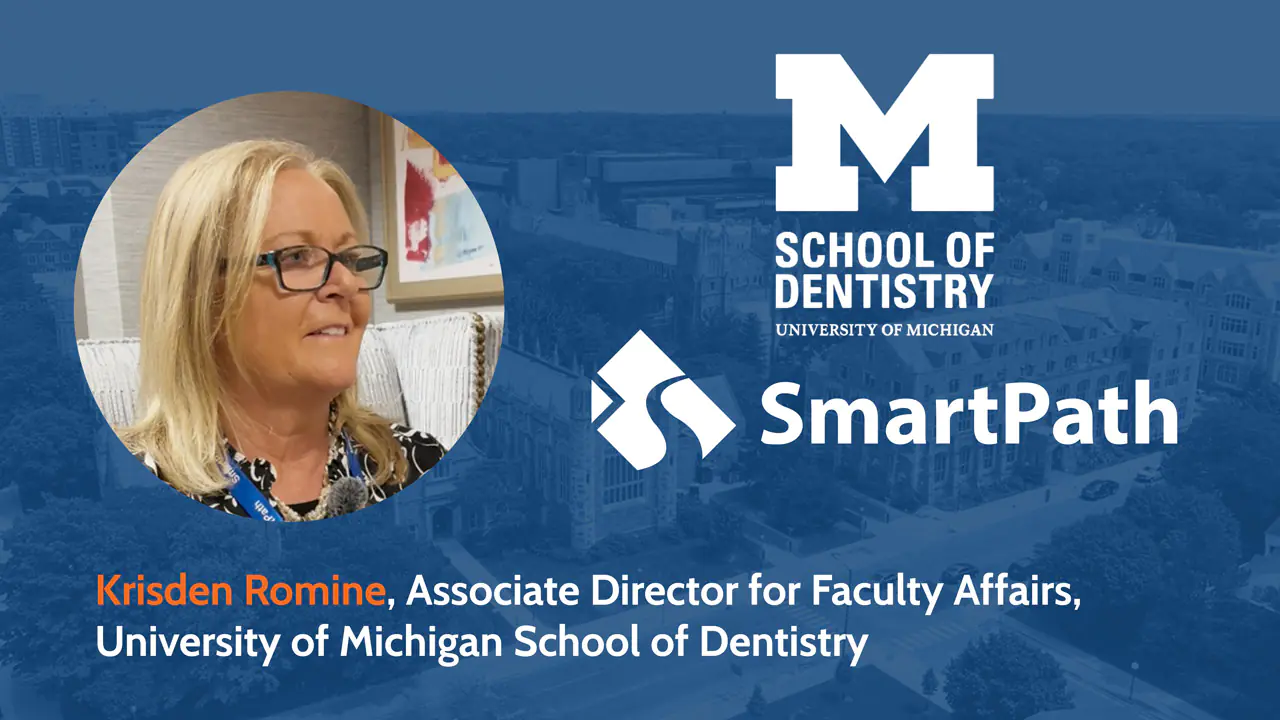
Krisden Romine watched this play out from the center of it. As the person responsible for faculty onboarding across the school, she had a front-row view of just how much inconsistency had crept into a process that, on paper, should have looked the same no matter where a new hire landed. What follows is her story: the shift that happened when the school moved from a patchwork of department-level habits to a single, shared workflow.
Watch Krisden Romine’s Story
One Dental School, Too Many Different Faculty Onboarding Processes
The core problem wasn’t a lack of effort. Every department was onboarding faculty in good faith, using whatever process had worked for them in the past. The trouble was that “worked for them” meant something different everywhere you looked: one department tracking steps in a shared spreadsheet, another relying on a chain of emails between the chair’s office and HR, a third following a checklist that hadn’t been updated in years but was still treated as gospel. None of these approaches was wrong on its own. Still, when stacked together across an entire institution, they created a level of inconsistency that made the process nearly impossible to manage centrally.
That inconsistency didn’t stay contained within individual departments. Downstream teams (credentialing, IT, academic affairs) had to constantly adapt to whichever version of the process a given department used, and staff supporting onboarding from the institution’s center had to relearn the rules every time they crossed a departmental line. That meant duplicated effort, missed steps, and a steady undercurrent of frustration for everyone involved.
As Krisden explains:
“Prior to SmartPath, each academic department would manage things how they felt things should go, and they might miss steps in the process; the flow was just different. So all of the other units at the school had to adapt to how each department did everything.”
That quote captures the problem precisely. Departmental autonomy wasn’t the issue; shared governance and departmental judgment matter in higher education for good reason. The issue was that autonomy had extended into areas where consistency actually served everyone better: tracking, visibility, and the basic mechanics of fully onboarding a new faculty member without confusion. And it wasn’t just inconsistency for its own sake: steps were genuinely getting missed, which meant the burden of catching those gaps fell on whichever downstream office happened to notice first.
One Shared Workflow Changed Everything
The shift began with a simple premise: departments could retain autonomy in how they made decisions, while the institution gained a single, shared workflow for how those decisions moved through the system. Instead of each department inventing its own tracking method, everyone (regardless of department) began using the same structured process inside SmartPath. The policies and nuances that mattered to each department didn’t disappear; they were simply built into a workflow that everyone could see and rely on.
Getting there required more than just turning on a new system. It meant understanding why each department’s process looked the way it did, and translating those real, legitimate differences into a shared structure rather than steamrolling them in the name of standardization. The goal wasn’t to force every department into an identical template; it was to build a system flexible enough to accommodate those differences without sacrificing the consistency the institution actually needed.
Visibility Replaced Guesswork
The most immediate change wasn’t a reduction in work; it was a reduction in uncertainty. Before the shared workflow, knowing the status of a given onboarding file often meant emailing someone and waiting for a reply. After it, that same information was visible to everyone with a stake in the process, in real time. Departments could see exactly where a file stood without interrupting anyone else’s day to ask.
That visibility had a compounding effect across the institution. Email volume dropped not because people stopped communicating, but because much of that communication had previously existed solely to answer “where are we on this?” Before the shared workflow, keeping a process moving often meant sending large volumes of emails just to collect information or connect with different units across the school. Collaboration between departments improved because everyone was now looking at the same source of truth rather than comparing notes after the fact. And accountability became shared in a way it hadn’t been before, not because anyone was being singled out, but because the workflow itself made every step, and every owner of that step, visible.
As Krisden said:
“Everybody can see where things are at or where things are stalled in the process… We can all go on SmartPath and see where things are at, and collaboratively keep things moving along.”
Cutting Faculty Onboarding Time in Half
The school ran a pilot early on to measure how long it took to bring in a new faculty member before and after SmartPath. The time was cut in half. That reduction occurred at a particularly consequential moment: the school, like many dental and clinical programs, was navigating faculty shortages in its clinics. Freeing up staffing time wasn’t a nice-to-have in that context; it directly affected how quickly the school could credential faculty and get them into the clinic — fewer hours spent chasing status updates and reconciling inconsistent processes meant more hours available for the other responsibilities that don’t pause just because onboarding is busy: promotions, reappointments, and the broader work of supporting faculty.
Krisden explains:
“We did a pilot early on: how long it took to bring in a new faculty prior to SmartPath and then after SmartPath. We cut the time in half. There are clinic shortages in terms of faculty, so it’s freed up staffing time. We can now focus on other things we have to do besides just onboarding, promotions, and reappointments.”
Key Takeaway
Reducing onboarding time wasn’t simply about efficiency. It gave the team greater capacity to support faculty and focus on higher-value priorities at a moment when clinic staffing pressures made that capacity more valuable than ever.
Before the Shared Workflow | After the Shared Workflow |
| Onboarding pace varied widely by department | Consistent onboarding timeline institution-wide |
| Status updates required direct outreach | Status visible to all stakeholders in real time |
| Staff time consumed by manual tracking | Staff time redirected to strategic priorities |
| Inconsistent packet quality | Standardized, cleaner faculty packets |
Faculty Notice the Difference
The impact of the new workflow wasn’t limited to the staff managing it; faculty felt it too. Most of the school’s faculty now have their CVs migrated directly into the system, which means every CV follows the same clean, organized format rather than whatever a given faculty member happened to build in a word processor. That consistency shows up most visibly in promotion packets: every packet that moves forward is clean and organized, in a shared format, before it ever reaches the Provost’s Office.
As Krisden said:
“Our faculty like it. We’ve gotten really good feedback from faculty. Most of our faculty have their CV migrated into the system now. It’s clean and organized, and all the CVs look similar, rather than everyone doing their own in a Word document. All the packets that go forward for promotion are very clean and organized, and we send them off to the Provost that way.”
None of this was the primary goal when the school set out to fix its onboarding inconsistency; the initial motivation was operational efficiency. But the ripple effect on faculty experience turned out to be just as significant, reinforcing something Faculty Affairs teams already know intuitively: the systems built to support administrative efficiency and the systems that shape how faculty experience an institution are, in practice, the same systems.
The Provost’s Office noticed the shift too. The school is now in its third year of running its promotion workflow through SmartPath, and the feedback on packet quality from that office has remained strong throughout, a signal that the consistency built into the process holds up over time, not just in an initial pilot. Even reaching out to external reviewers during the promotion process, once a heavier lift, now takes only a couple of clicks.
Built Around Higher Education, Not Retrofitted for It
Part of what made this shift possible was that the underlying platform was designed around the reality of higher education rather than adapted from a generic workflow tool. The school didn’t need to force every department into an identical process that ignored real differences in how departments operate; it needed a system flexible enough to preserve what made each department’s needs unique while still creating one shared structure for visibility and accountability.
That combination (deep configurability paired with genuine partnership) is what allowed the school to move from a patchwork of habits to a unified workflow without asking departments to give up the judgment calls that shared governance depends on. Part of what makes that possible, in Krisden’s experience, is the team behind the platform. She’s brought genuinely difficult configuration challenges to the SmartPath team, the kind where, at first, no one is sure how it will be solved, and every time, the team has come back with a workable solution. That responsiveness, she notes, is exactly what a product needs when every school and college does things a little differently, and the system has to adapt to each one.
“I feel like the possibilities are endless. I’ve thrown some really difficult ones to the SmartPath team, and there have been a couple of times they’ve said, ‘We don’t know how we’re going to do this.’ They go back, they meet, and every single time the team comes back with a solution, a really good solution that works. I’m sure every school and college has a different way of doing things, so they have to adapt; it’s just a very adaptable product.”
Better Workflows Build Stronger Campus Partnerships
What started as a fix for onboarding inconsistency ended up strengthening something harder to quantify: a genuine sense of community around bringing in new faculty. Faculty onboarding and promotion at a school like this involve groups spread across different areas of campus (credentialing, licensure, internal approvals, appointment letters, contracts), all of which must come together before a new faculty member can begin seeing patients in the clinic. Bringing those groups together around a shared, cohesive process means every new faculty member is fully credentialed and has licensure on file before they ever step into the clinic.
As Krisden said:
“Partnering with SmartPath has brought a sense of community in terms of bringing in new faculty at the school. When faculty are up for promotion, there are various different groups within the school that are part of these processes, and we’re not all in the same area. Bringing these groups together gives us a more cohesive onboarding and makes sure all our faculty are credentialed before they clinic: that we have all their licensure on file, all our internal approvals met, letters and contracts in place. There are so many facets that go into bringing in a faculty member before they can go into the clinics.”
This is the story of one dental school. Still, the underlying pattern (departmental autonomy colliding with the need for institution-wide visibility) is one Faculty Affairs teams across higher education will recognize immediately. SmartPath’s role wasn’t to erase what made each department distinct. It was to give the institution a shared foundation flexible enough to honor those differences while still delivering the consistency, visibility, and speed that faculty, staff, and leadership all deserve.
Curious what a unified onboarding workflow could look like at your institution?